A blown tire on a heavy motorhome isn’t just a flat. It can tear up the wheel well, the wiring that runs through it, and the rest of your trip. The gear that prevents the worst days on the road is cheap next to the repair.
These are the three things we’d add before a long trip. None of them makes the coach more comfortable. All of them make it less likely you’ll spend a night on the shoulder.
Our picks
Tire monitor
Our pick
TireMinder TPMS
Shows a slow leak on the dash before it turns into a blowout.
Why we like it
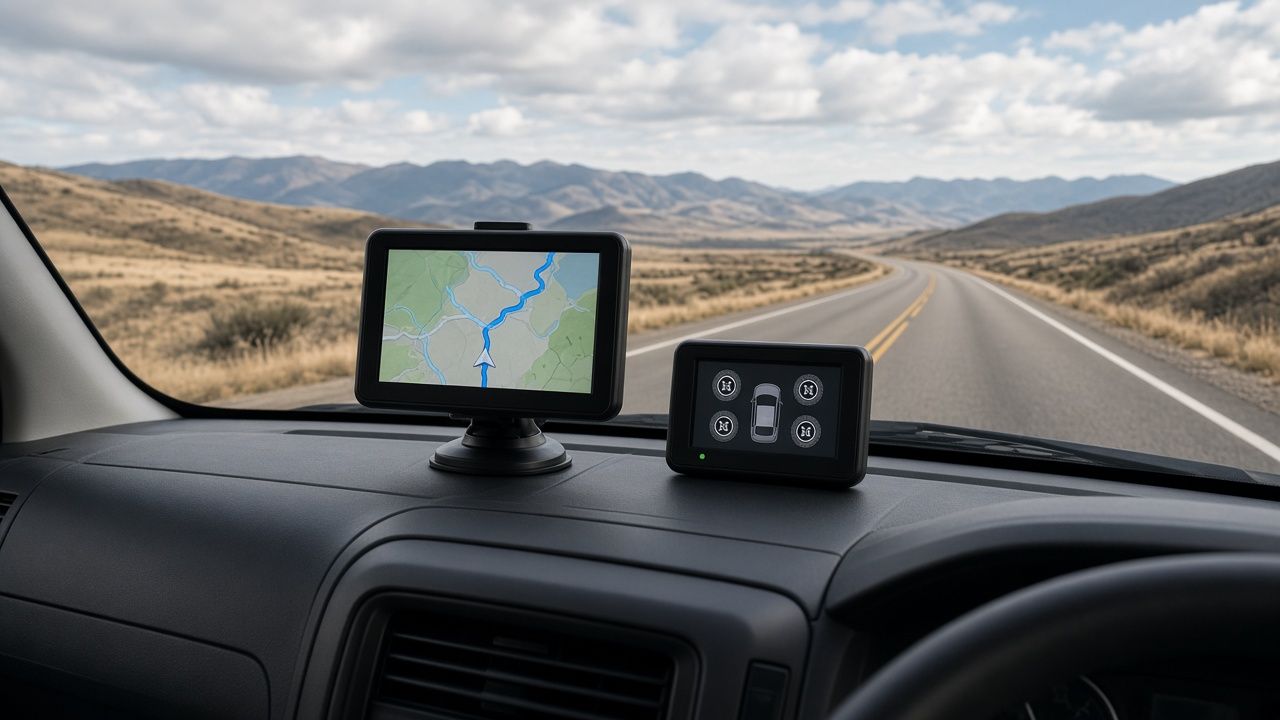
A tire pressure monitoring system (TPMS) puts a sensor on each valve stem and shows the readings on a screen up front. You can't feel a soft tire on a big coach, and you definitely can't see the ones on a towed car.
Who it’s for
Everyone with a motorhome or trailer. It matters most if you tow a car or run dual rear wheels, where a low inside tire hides behind the outside one.
Flaws but not dealbreakers
Every tire needs its own sensor, and long rigs may need a signal booster. Check how many sensors come in the box against the number of tires you have.
Navigation
Our pick
Garmin RV GPS
Routes around low bridges because it knows how tall you are.
Why we like it
An RV GPS lets you enter your rig's height, length, and weight, then plans routes that fit. A phone map treats your coach like a sedan.
Who it’s for
Anyone driving a Class A or towing a fifth wheel, especially on back roads and in older towns.
Flaws but not dealbreakers
The routing is only as good as the numbers you give it. Measure the real height to the top of the roof air, and keep the maps updated.
Weather
Our pick
Midland emergency weather radio
Gets the storm warning when your phone has no bars.
Why we like it
A weather radio picks up broadcast alerts without a cell signal, which is exactly where boondockers tend to end up.
Who it’s for
Anyone who camps away from town, and anyone in a high profile coach where wind is a real risk.
Flaws but not dealbreakers
Set it up and test it at home, not during the storm. Check the listing for the power options (batteries, hand crank, or solar).
Tires first
Tires sit at the top of the pre-trip list in the 2019 Fleetwood Bounder manual: check all tire pressures and inspect the tires and wheels before you travel. In storage, it says to keep tires at maximum inflation pressure.
A monitor doesn’t replace that walk-around. It covers the hours in between. The pre-trip checklist has the rest of the list and saves your progress on this device.
Routing and fuel
A route that fits your coach is also a route with fewer surprises at the pump. The fuel savings calculator shows what slowing down a few miles an hour can save on a long leg.
Wind
Big flat sides catch wind. Before you drive into a gusty forecast, run your coach through the max wind calculator. It’s an estimate, so treat it as a reason to wait, not permission to go.
Spot something wrong or out of date? Tell us and we'll fix it.
How much of the label you can actually use, what the Megawatt calculator picks for compact, mid-size, and luxury rigs, and where AGM still makes sense.