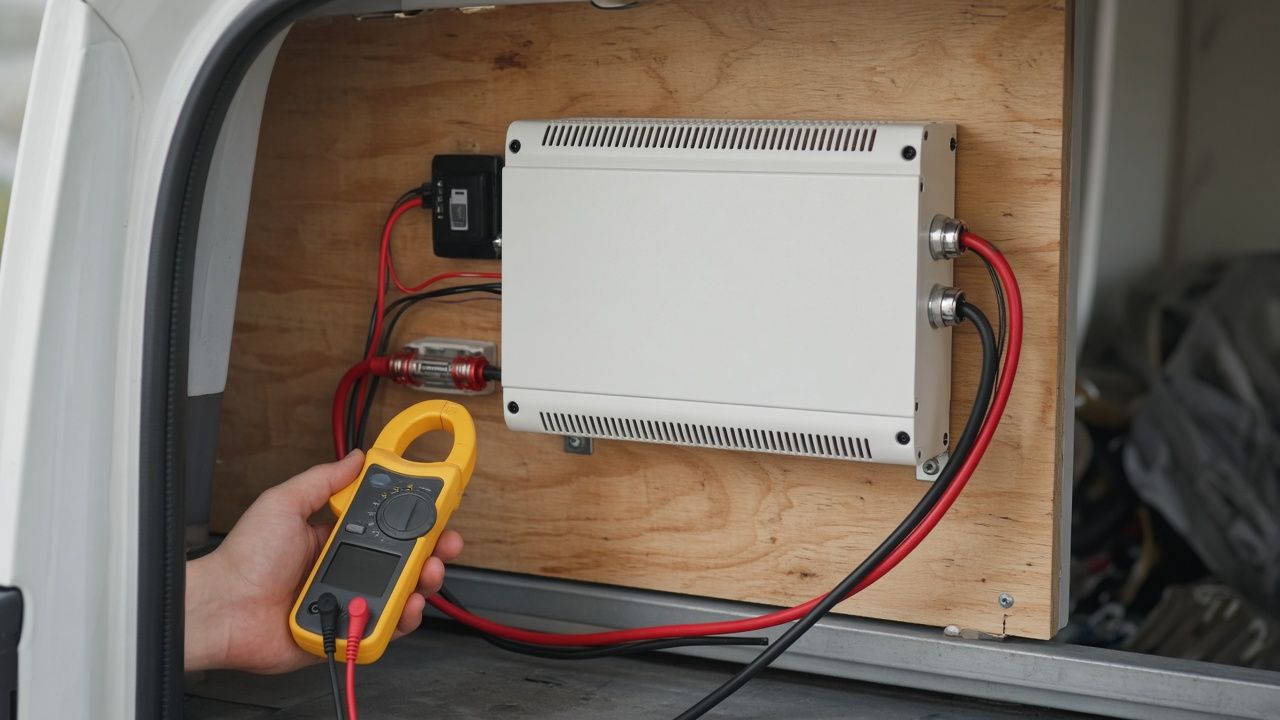
An inverter that’s too small trips the moment the microwave and the coffee maker run together. One that’s too big costs more than it should and burns battery just sitting there. The number that settles it is simple: the watts that run at the same time.
We don’t have an inverter pick yet. There’s no inverter in Megawatt’s affiliate lineup, and we’d rather say so than dress up a battery link as one. We can still get you to the right size, and point you to the battery that has to feed it.
Watts, not watt-hours
Daily watt-hours tell you how big the battery bank should be. Inverter size comes from peak watts: everything that can be on at once. The Megawatt battery calculator adds those up from the appliances you check.
Compact defaults: 390 W at once
Mid-size defaults: 1,450 W
Luxury Class A defaults: 2,300 W, because the outlet package includes the microwave and coffee maker
Check the air conditioning box on a luxury coach and the peak jumps by another 4,500 W.
Add a margin, then round up
The Megawatt solar planner multiplies your peak by 1.25 and rounds up to the next common size between 1,000 and 6,000 W. The extra room keeps the inverter from running flat out on a hot afternoon.
Compact: 390 W times 1.25 is 488 W, so a 1,000 W inverter
Mid-size: 1,450 W times 1.25 is 1,813 W, so 2,000 W
Luxury: 2,300 W times 1.25 is 2,875 W, so 3,000 W
That 1.25 is our planning margin, not a code requirement. If your installer uses a different one, go with theirs.
Surge is the part that bites
Motors and compressors pull several times their running watts for a moment when they start. A roof air conditioner is the classic case.
Look for the surge rating on the inverter listing, then find the start-up draw in the appliance manual. The first number has to be bigger than the second. If you can’t find the start-up figure, ask the appliance maker before you buy.
Match the battery voltage
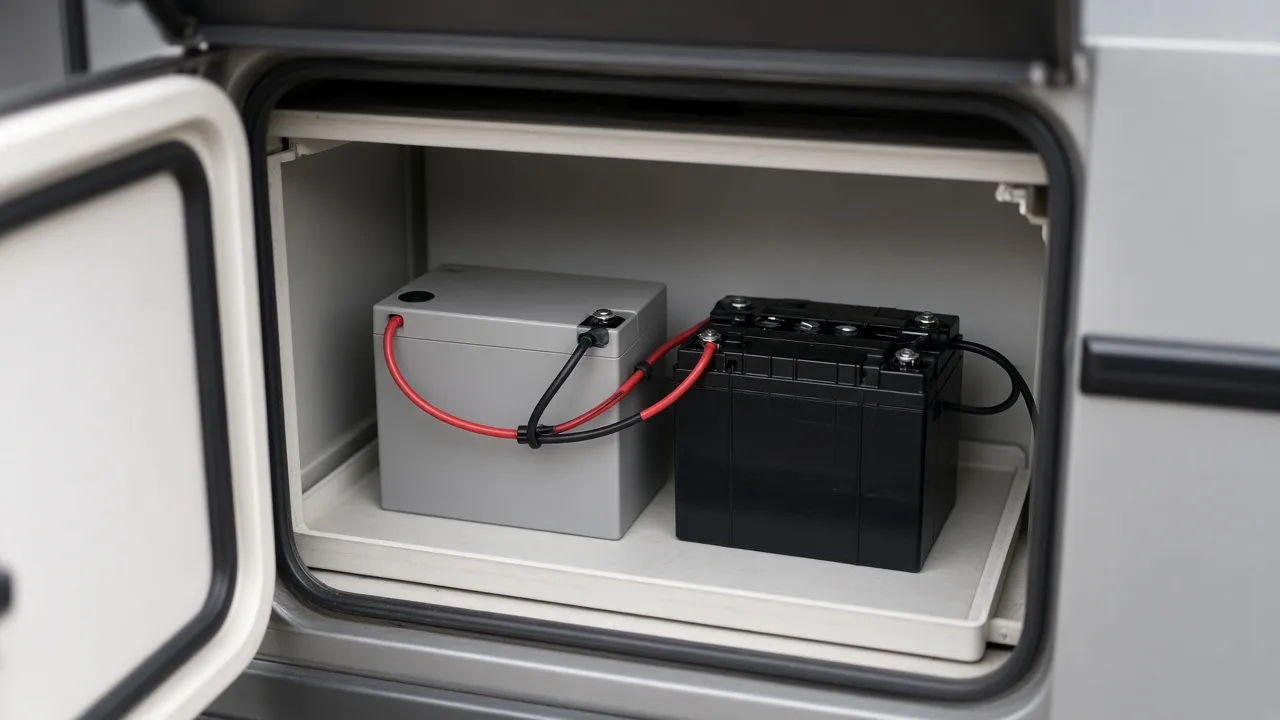
Peak watts also set the battery voltage in the calculator. Up to 3,000 W it stays at 12 V. From there to 5,000 W it moves to 24 V, and above that to 48 V.
The reason is current. A 3,000 W inverter on a 12 V bank pulls well over 200 amps at full load, which means very thick cable and big fuses. Doubling the voltage halves the current. Run your cable length through the wire size calculator before you buy anything.
12 V systems
Our pick
Vatrer 12V 300Ah
Feeds a 2,000 or 3,000 W inverter without leaving 12 V.
3,840 WhStored at 12.8 V nominal
Why we like it
Up to 3,000 W at once, the calculator keeps you at 12 V. This 3,840 Wh pack is what it picks for compact and mid-size coaches on their default loads.
Who it’s for
Coaches with a 1,000 to 3,000 W inverter that mostly runs the fridge, TVs, chargers, and short bursts of the microwave.
Flaws but not dealbreakers
At the top of that range the battery to inverter cable gets thick and expensive. Keep the run short, and fuse it to the cable size.
24 V systems
Upgrade pick
Vatrer 24V 200Ah
The 24 V step for coaches past 3,000 W at once.
5,120 WhStored at 25.6 V nominal
Why we like it
Once your peak passes 3,000 W, the calculator moves to 24 V. This 5,120 Wh pack (25.6 V times 200 Ah) is the smaller of the two 24 V batteries Megawatt links.
Who it’s for
Owners planning a 4,000 or 5,000 W inverter, usually to run a roof air conditioner from batteries for short stretches.
Flaws but not dealbreakers
Your lights and pumps still run on 12 V, so a 24 V bank also needs a 24 to 12 V converter. Pair it with an inverter and charger built for 24 V.
Vatrer 24V 300Ah
7,680 Wh at 24 V, when one 200 Ah pack isn't enough.
Have a certified electrician look over the plan before you modify the coach’s electrical system. Inverters touch both the 12 V side and the 120 V outlets, and mistakes there don’t stay small.
Spot something wrong or out of date? Tell us and we'll fix it.
How much of the label you can actually use, what the Megawatt calculator picks for compact, mid-size, and luxury rigs, and where AGM still makes sense.
The dry camping habits from the Fleetwood manual, the one load that ends a quiet night, and the battery and solar we'd pair for two or three nights out.